


You wake up in Big Bear, turn the shower on, and get a blast of cold water. You head to the garage or utility closet, relight the water heater, and it works for a while. Then it goes out again. That pattern usually means the pilot isn’t the underlying problem. It’s the symptom.
In mountain homes and vacation rentals, this gets old fast. Guests don’t care that the flame relit once. They care that hot water disappeared before checkout. Homeowners feel it too, because water heating uses about 24% of a typical four-person household’s total energy, according to the U.S. Energy Information Administration, as cited here by Precise Plumbing. When the pilot keeps dropping out, comfort and efficiency both take a hit.
Understanding why pilot light goes out
On a cold Big Bear morning, the usual call starts the same way. The pilot was relit last night. Everyone thought the problem was solved. By sunrise, no hot water again.
That tells you one thing right away. A water heater pilot light keeps going out because something is failing to keep that small flame stable, or something is telling the gas valve to shut down for safety. Older gas water heaters depend on a pilot that stays lit and heats the thermocouple. If the flame weakens or shifts away from the sensor, the system cuts gas flow.
What usually causes it
A handful of problems show up over and over:
- Thermocouple trouble that keeps the gas valve from recognizing a good flame
- Drafts moving through garages, closets, crawlspaces, or basement-style utility areas
- Pilot tube or orifice buildup that starves the flame
- Gas supply or control issues that create a weak or inconsistent burn
- Altitude-related combustion problems that standard sea-level advice often misses
In Big Bear, draft and combustion issues tend to overlap. A flame might look acceptable when the room is still, then flutter the moment cold outside air moves through the space.
A pilot should look calm, not nervous. If it flickers, lifts, or burns yellow, treat that as a clue, not a quirk.
Why this matters more than people think
A failing pilot doesn’t just interrupt showers. It can force repeated relighting, conceal a venting problem, and create recurring complaints in short-term rentals. That urgency is one reason owners of RVs and cabins often compare notes across appliance types. If you also manage a trailer or guest unit, this guide on Atwood RV water heater problems is useful because many of the same symptoms point back to ignition, airflow, and gas delivery.
The good news is that most pilot failures leave evidence. Flame color, flame shape, soot, moisture, and the way the pilot behaves when you release the control button all help narrow it down. The trick is checking them in the right order, without skipping the safety steps.
Preparing safely before relighting pilot
Before you touch the control knob, slow down. Gas appliance troubleshooting goes better when the setup is controlled and boring. Rushing is how people miss a gas smell, cross-thread a fitting, or relight before residual gas has cleared.
Start with the basics
Use this checklist before any relight attempt.
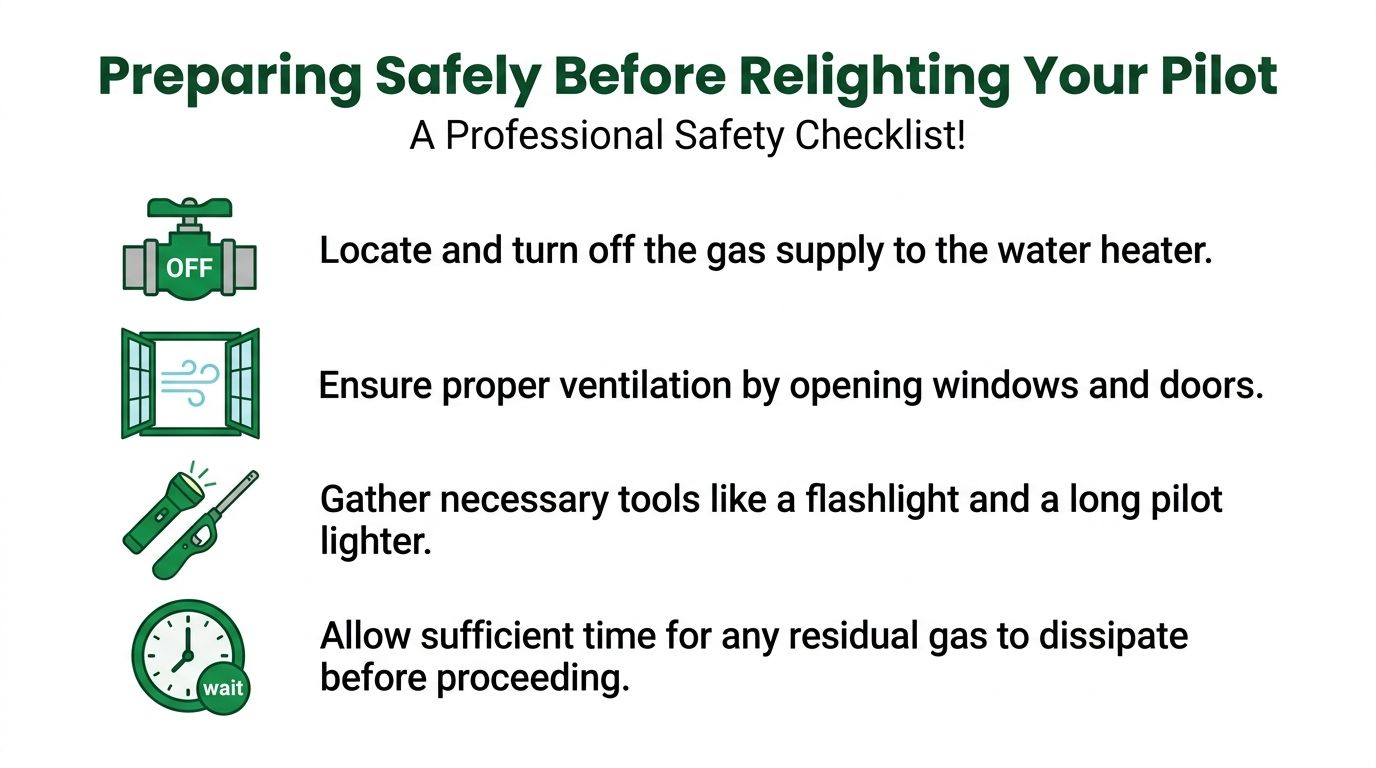
- Turn the gas control to OFF. Leave it there long enough for any unburned gas to dissipate.
- Open the area up. Crack a door or window if the heater is indoors and the room allows ventilation.
- Gather tools first. A flashlight, long lighter if your model needs one, work gloves, and a screwdriver are the basics.
- Check for obvious damage. Loose access panels, scorch marks, corrosion, heavy soot, or water around the base all change the job.
- Keep a fire extinguisher nearby. You probably won’t need it, but this isn’t the place to improvise.
- Read the unit label. The manufacturer’s lighting sequence matters.
Know what you should never ignore
If you smell gas strongly, stop. Don’t keep trying to relight. Don’t cycle the valve repeatedly. Don’t assume the smell will fade on its own.
For homeowners who want a better grasp of hazard information, the MSDS for Natural Gas gives a useful overview of handling and exposure concerns in plain terms.
Practical rule: If the water heater has both pilot trouble and signs of leaking, corrosion, or moisture, treat it as more than an ignition problem.
That’s especially true if your issue started after you noticed water at the base of the tank. In that case, this local guide on what to do if your water heater is leaking in Big Bear is worth reviewing before you spend time relighting a unit that may have a larger failure.
Tools that help and habits that don’t
Helpful:
- Flashlight for seeing flame shape and soot
- Nut driver or small wrench if access panels need removal
- Work gloves for hot or sharp sheet metal edges
- Soapy water for checking accessible joints if you suspect a minor leak after reassembly
Not helpful:
- Forcing stuck knobs
- Using random wire or needles in gas openings
- Relighting repeatedly without observing the flame
- Working in a closed, stale space
A safe relight starts with a clean setup. If the area feels off, smells off, or looks off, that’s the point to stop and reassess.
Performing diagnostic checks for outages
Most recurring pilot failures can be narrowed down with a visual inspection and a few simple tests. Don’t start by replacing parts. Start by observing what the heater is doing.
One important clue is airflow. Drafts and poor ventilation account for up to 30 to 40% of pilot light outages in residential water heaters, especially in mountain homes where cold air infiltrates utility spaces, as noted by Woods Comfort Systems. In Big Bear, that shows up constantly in garages, under-house utility areas, and cabins with older door seals.
Read the flame before touching anything
A steady pilot tells you a lot.
- Stable blue flame usually points away from immediate pilot instability
- Yellow or lazy flame suggests poor combustion, dirt, or gas delivery trouble
- Flickering flame often means draft interference
- Flame that won’t stay on the thermocouple points to alignment or sensor trouble
If the unit isn’t producing hot water at all, it also helps to separate pilot issues from broader heater failure. This page on a water heater not producing hot water lays out other system-level causes that can mimic pilot trouble.
Diagnostic checks summary
| Component | Symptom | DIY test | Professional fix |
|---|---|---|---|
| Thermocouple | Pilot lights, then dies when knob is released | Check whether the flame fully contacts the thermocouple tip. Look for soot, bending, or loose connection | Clean, realign, test output, or replace |
| Pilot flame | Flame is weak, yellow, or split | Watch flame through access opening in a still room and then again when nearby doors open | Clean pilot assembly, correct air-fuel issues, evaluate altitude setup |
| Draft and ventilation | Pilot goes out during wind, door movement, or cold nights | Stand near the heater and feel for air movement around lower openings and vent path | Correct venting, room air supply, enclosure issues |
| Pilot tube or orifice | Flame is small even after relight | Inspect for visible dirt or soot around burner area. Don’t enlarge openings with improvised tools | Proper cleaning of pilot tube and orifice |
| Gas supply | Flame looks inconsistent, other gas appliances also seem off | Confirm shutoff valve is fully open and note whether issue coincides with other gas problems | Gas pressure testing and supply diagnosis |
| Gas control valve | Pilot behavior is erratic despite clean flame path | Note intermittent shutoff pattern after the unit warms up | Valve testing and replacement |
What you can check yourself
Thermocouple position
A thermocouple has one job. It must sit in the pilot flame and get hot enough to prove the flame is real. If it’s bent away, coated with soot, or loosely mounted, the gas valve may shut down even though you just relit it.
Look for:
- A sensor tip outside the strongest part of the flame
- Dark buildup on the metal
- A loose mounting bracket
- A connection at the gas valve that feels sloppy
Air movement around the heater
Open garage doors, exhaust fans, louvered doors, and leaky utility rooms can all affect a pilot. In Big Bear, outside air intrusion can be dramatic enough that the pilot behaves differently at night than during the day.
Try a simple pattern check. Observe the pilot with nearby doors closed, then again after opening the garage door or a service door. If the flame changes shape, you’ve found a useful clue.
If the pilot only fails when weather changes or doors open, don’t assume the water heater itself is worn out.
Signs of clogging or soot
Remove the access cover and inspect the burner compartment. Dust, lint, spider webs, and soot all matter. A dirty pilot assembly can create a small, unstable flame that never properly heats the safety sensor.
What doesn’t work is stabbing at the opening with a nail, pin, or paper clip. That often damages the orifice and creates a different problem.
When the job stops being DIY
Call for service if you notice any of these:
- Persistent gas odor
- Heavy soot buildup
- Repeated pilot dropouts after cleaning and relight
- Evidence of venting trouble
- A yellow flame that won’t correct
- Intermittent shutdown that seems tied to the gas control valve
Those signs usually mean you’ve moved past basic cleaning and into combustion, venting, or gas-control diagnosis.
Relighting and cleaning pilot light correctly
If the heater passed the safety check and your inspection points to a dirty pilot or thermocouple, careful cleaning and relighting may solve it. Technique is important. A rushed relight can make you think the repair failed when the thermocouple didn’t heat long enough.
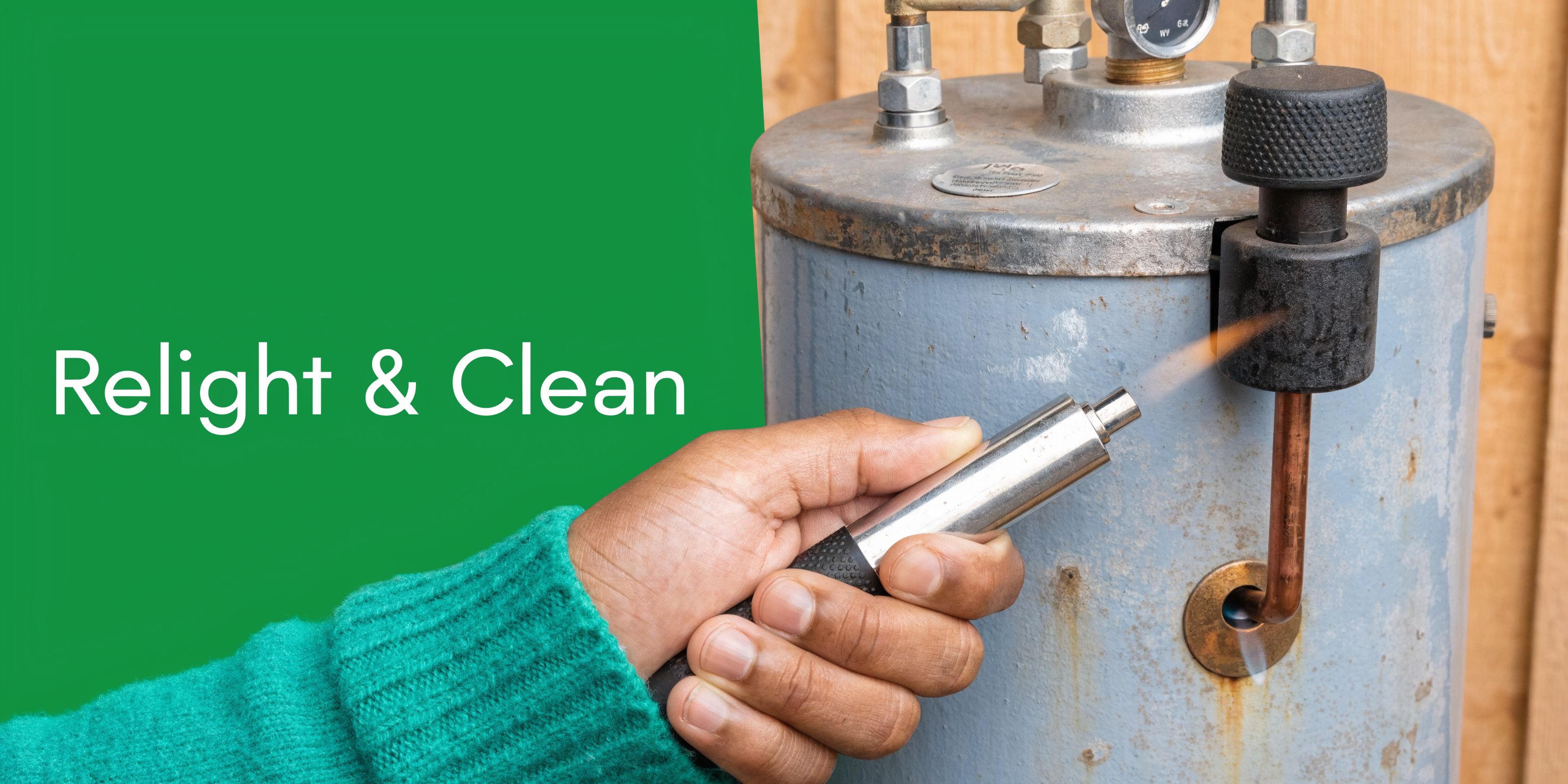
Thermocouple failure causes about 70 to 80% of pilot light extinguishments, with cleaning or replacement restoring reliability in most cases, according to Call Oasis. That’s why this part gets so much attention in the field.
Cleaning the parts that affect flame quality
Start with the burner compartment cool and the gas supply off.
Clean the thermocouple gently
Use fine abrasive material if the tip is sooty. The goal is to remove buildup, not grind the metal down.
Good practice:
- Wipe away loose debris first
- Clean only the sensor surface
- Check that the tip sits where the pilot flame can wrap it
- Tighten the connection snugly, not aggressively
If the thermocouple is bent, correct the alignment carefully. If it’s kinked, badly corroded, or won’t hold position, replacement is the better move.
Clear loose debris near the pilot
Dust and lint around the burner tray affect flame stability. A soft brush and careful vacuuming around the compartment can help. Don’t jam tools into the pilot opening.
In Big Bear cabins, I’ve seen heaters relit over and over when the underlying issue was contamination from long periods of vacancy, sawdust from recent work, or dust pulled in through a drafty enclosure.
Relight with patience
Manufacturer instructions come first, but the general sequence is straightforward.
- Set the control to OFF and wait.
- Turn to PILOT after the wait period.
- Press and hold the pilot control.
- Ignite the pilot with the built-in igniter or a long lighter if your model requires it.
- Keep holding the control until the thermocouple has fully heated.
- Release slowly and watch whether the pilot remains steady.
- Turn the control to ON only after the pilot stays lit.
Big Bear altitude changes the feel of this step
At higher elevation, ignition can be fussier. The flame can be weaker, and the appliance may need a little more care during relight. If you let go too soon, the pilot may drop out even though the parts are basically fine.
Watch for these mountain-specific clues:
- Pilot takes longer to stabilize
- Flame looks softer than expected
- Soot returns quickly
- Condensation or cold-air movement affects the burner area
A clean pilot that still burns yellow in Big Bear often points beyond dirt. It may be an air-fuel or altitude setup issue.
What success looks like
After relighting, stay with the heater for a few minutes. Don’t relight and walk away.
You want to see:
- A steady blue pilot
- Flame contact on the thermocouple
- No fluttering when the room is still
- Reliable burner ignition when the heater calls for heat
If the pilot lights but won’t remain stable, cleaning wasn’t enough. If it stays lit until the burner cycles, then fails later, shift your suspicion toward draft changes, gas control issues, or altitude-related combustion problems.
DIY repair options and part replacements
Once cleaning fails, the next question is simple. Is this a good DIY repair, or is it time to stop and hand it off?
Not every pilot problem deserves the same response. Some repairs are sensible for a careful homeowner. Others carry enough gas, combustion, or adjustment risk that they’re better left alone.
What usually makes sense to do yourself
The safest DIY repairs are the ones that don’t require altering gas delivery or venting design.
Realigning a bent thermocouple
If the sensor has been nudged out of the flame path, careful repositioning is often worth trying. This is low-cost, fast, and sometimes all the heater needs.
Best case:
- The pilot is healthy.
- The thermocouple is intact.
- The issue is only flame contact.
Downside:
- If the bracket is loose or the metal is fatigued, the fix may not hold.
Replacing the thermocouple
A straightforward thermocouple swap is one of the more reasonable DIY repairs on an older standing-pilot unit, provided you can match the part correctly and reassemble the burner components properly.
Pros:
- Common failure point
- Manageable repair on many heaters
- Good payoff when the flame looks right but the pilot won’t stay lit
Cons:
- Easy to misroute or misalign during reassembly
- A bad install can create repeat shutdowns that look like a part failure
What’s usually not worth improvising
Cleaning a clogged pilot orifice aggressively
A light surface cleaning is one thing. Trying to ream out a tiny gas opening with random household tools is another. That can distort the opening and change flame behavior.
If the flame is clearly starved and basic cleaning didn’t help, proper service is the safer path.
Replacing the gas control valve
Many DIY jobs become impractical at this point. The gas control valve affects pilot gas, burner gas, and safety shutoff behavior. If it’s defective, replacing it involves more than swapping a part and hoping for the best.
The trade-off is simple:
- Possible upside is restoring a heater that otherwise still has useful life.
- Real downside is getting the diagnosis wrong and spending time on the most sensitive gas-side component.
A simple decision guide
Choose DIY when:
- The flame issue is visible and limited
- The repair is a thermocouple clean, reposition, or straightforward replacement
- You can follow the manufacturer sequence without guessing
Call for service when:
- The flame stays yellow or unstable after cleaning
- The pilot outage seems weather-related but inconsistent
- You suspect gas pressure, venting, or control-valve behavior
- This is a vacation rental and downtime matters more than squeezing out one more DIY attempt
For rental owners, the practical question isn’t just “Can I fix this?” It’s “Will this stay fixed through the next guest turnover?” That answer often separates a quick homeowner repair from a service call that solves the root cause.
Preventing future outages and professional help
A pilot light that keeps going out usually gives warnings before it becomes a full no-hot-water problem. The best prevention plan is not complicated. It just needs to be consistent, especially in Big Bear where cold air, thinner air, and seasonal vacancy all make gas water heaters less forgiving.
One local factor matters more than most generic guides admit. At elevations above 5,000 feet, gas appliances require derating of about 4% per 1,000 feet, and unadjusted units often produce sooty flames that self-extinguish in high-altitude climates, as noted by Constellation Home. That’s a real issue in Big Bear. A heater that behaves acceptably in lower elevations may struggle here if combustion setup is off.
Prevention that actually helps
The goal is to catch flame instability before the pilot starts dropping out.
- Check the pilot visually when seasons change, after storms, or after long vacancy periods.
- Keep the burner area clean so lint, dust, and debris don’t weaken combustion.
- Watch for soot because soot is information. It says the flame isn’t burning cleanly.
- Notice airflow changes after remodel work, new doors, vent changes, or enclosure changes.
- Pay attention to relight behavior because a pilot that suddenly needs extra tries is telling you something.
For a fuller maintenance routine, this local guide on preventive maintenance on a hot water heater is a good companion read.
Big Bear and vacation rentals need a stricter standard
Owner-occupied homes can sometimes tolerate a minor nuisance for a week. Vacation rentals can’t. If a guest loses hot water on a winter weekend, the cost isn’t just inconvenience. It becomes a service scramble, a review problem, and often an after-hours call.
That’s why rental properties should treat these signs as immediate-action issues:
- Pilot drops out more than once
- Flame turns yellow
- Soot appears around the access area
- The heater behaves differently during cold snaps
- Hot water failures cluster around guest turnover or high-demand periods
Don’t grade a water heater on whether it worked yesterday. Grade it on whether you trust it this weekend.
When professional service is the smart move
Professional diagnosis is the better call when the problem touches combustion setup, venting, gas pressure, or altitude correction. Those issues don’t always announce themselves clearly. They often look like a “bad pilot” until someone tests the whole system.
That’s also where a licensed technician brings real value. Not because every pilot outage is dramatic, but because recurring outages often involve several small issues at once. A little soot, a little draft, and a slightly weak thermocouple can combine into one stubborn problem.
If your water heater pilot light keeps going out and you’ve already cleaned, relit, and checked the obvious items, don’t keep cycling the same fix. Repeated relights don’t cure a bad flame pattern or a mountain-combustion problem.
If your water heater pilot light keeps going out in Big Bear, Bear Valley Plumbing & Heating can help with fast, professional troubleshooting and repair. Their licensed C-36 plumbing and C-20 HVAC technicians serve the Big Bear area year-round, with 24/7 emergency service, written estimates, and a 5-year parts and labor warranty on installations. When you need reliable hot water back without guesswork, they’re the local team to call.
If you are looking for a Big Bear plumbing, heating & air conditioning contractor, please call (909) 584-4376 or complete our online request form.
Category: Plumbing Replacement
